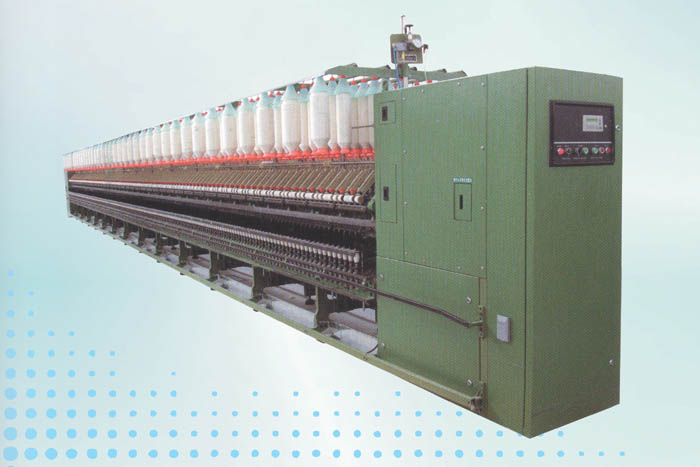
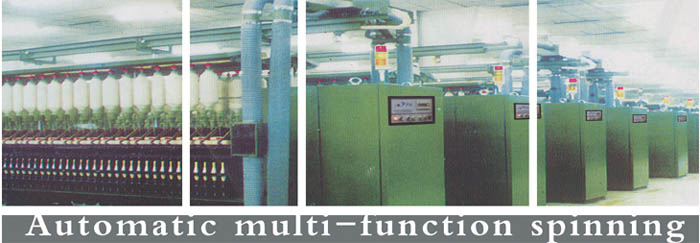
Introduction to the Fully Automatic Multifunctional Spinning Frame:
Nantong Jinchi Electromechanical Co., Ltd., a high-tech enterprise in Jiangsu Province, has developed a fully automatic multi-functional ring spinning machine. This innovation offers spinning mills an excellent solution for enhancing efficiency, improving yarn quality, expanding product diversity, reducing production costs, lowering energy consumption, decreasing labor requirements, and alleviating worker fatigue.
Ring spinning frames are among the most energy-intensive and labor-intensive equipment in spinning mills, with operators and maintenance technicians facing high workloads. Their quality directly impacts yarn quality. Since the 1960s, the FA506 from Jingwei Textile Machinery and the FA507 from Shanghai Textile Machinery have featured well-designed structures and stable transmission systems. These models remain mainstream in modern spinning mills, contributing significantly to the textile industry's development. Subsequently, many manufacturers introduced innovations like oil-lubricated headboxes and centralized yarn-discharging systems to optimize structures and spinning processes, propelling ring spinning technology forward in a major leap.
I. With advances in science and technology, rising living standards, and growing pressures on energy and labor resources, the following issues with ring spinning frames have become increasingly prominent:
1. Open gear transmission: Produces high noise levels, prone to gear wear, generates significant mechanical vibrations that adversely affect yarn quality, and requires substantial maintenance work;
2. Process adjustments necessitate replacing a series of transmission gears, which is extremely inconvenient, labor-intensive, and time-consuming;
3. Open transmission with poor sealing leads to oil contamination and environmental pollution;
4. Forming cams with low manufacturing precision generate high impact forces, causing equipment damage;
5. Multiple transmission stages result in low transmission efficiency, leading to electricity waste.
II. After analyzing the strengths and weaknesses of ring spinning frames both domestically and internationally, Jinchi Company independently developed a fully automatic CNC spinning frame with the following advantages:
1. Utilizes PLC control, a touchscreen human-machine interface, and high-precision encoder-based spindle sampling and follow-up technology to control high-precision, high-torque servo motors, ensuring consistent motor synchronization. High control precision accommodates a wide range of yarn types currently produced by domestic spinning frames (standard yarns from 4s to 120s; fancy yarns including slub yarn, variable twist yarn, segmented color yarn, segmented slub yarn, segmented plain yarn, etc.).
2. Utilizes an electronic drafting system, enabling convenient changeovers and process adjustments without gear replacement. This saves working time, enhances efficiency, and reduces labor intensity. Process technicians can spin different yarn types and specifications simply by inputting parameters on the touchscreen.
3. High-precision, high-torque servo motors control synchronous pulleys and belts to independently regulate the front, middle, and rear rollers. This ensures smooth transmission, low noise, and elimination of mechanical waves, thereby enhancing yarn quality.
4. Process varieties are managed via computer systems with digital order placement and USB data transfer, minimizing loss of process data—particularly critical for slub yarn, variable twist yarn, and segmented color yarn—while reducing operator workload;
5. Synchronous belt transmission eliminates lubrication requirements throughout the machine (except bearings), ensuring workshop cleanliness;
6. Synchronous belt transmission between the main motor and spindle resolves radial bearing loads, extending bearing life. This ensures smooth transmission, stable spindle speed, increased machine speed, and higher output;
7. Yarn tube formation is driven by a servo motor and high-precision gearbox. For spinning different yarn counts, operators input relevant parameters on the touchscreen to control the lifting of the creel plate, guide plate, and air ring. Lifting is smooth and impact-free, ensuring excellent yarn formation and eliminating yarn defects.
8. The headstock drive employs servo motors with synchronous belts, eliminating complex and vulnerable mechanical transmission systems like headstock gears, worm gearboxes, and ratchets. This creates a clean headstock interior free of wear-prone components, reducing maintenance costs, minimizing reactive power losses, and cutting expenses;
9. Absence of mechanical losses achieves over 20% energy savings.
III. Process Parameter Input
(A) Spinning Standard Yarn:
Input parameters such as spindle speed, twist, front zone draw ratio, total draw ratio, initial spinning height, lifting stroke, initial stroke, forming pitch, stroke transmission ratio, and full yarn height according to spinning requirements.
(B) Spinning Patterned Yarn:
1. Slub yarn: After entering standard yarn parameters, input process-specific parameters including slub length, slub pitch, magnification ratio, slub shape, and regularity/irregularity rate.
2. Variable twist/count: Input process parameters according to yarn count variation requirements.
3. Segmented colored yarn:
⑴ Colored dot yarn: Produce yarn with colored dots by randomly adding a secondary fiber to a primary yarn strand.
(2) Segmented Color Plain Yarn: Alternate feeding of two colors or fibers creates patterned yarn with uniform thickness;
(3) Segmented Color Slub Yarn: Two colors or fibers simultaneously form slubs, while the base yarn remains a single color or fiber.
IV. For complete machine purchase, please read the detailed manual. This design incorporates patented technology. Thank you for your patronage.



 中文版
中文版